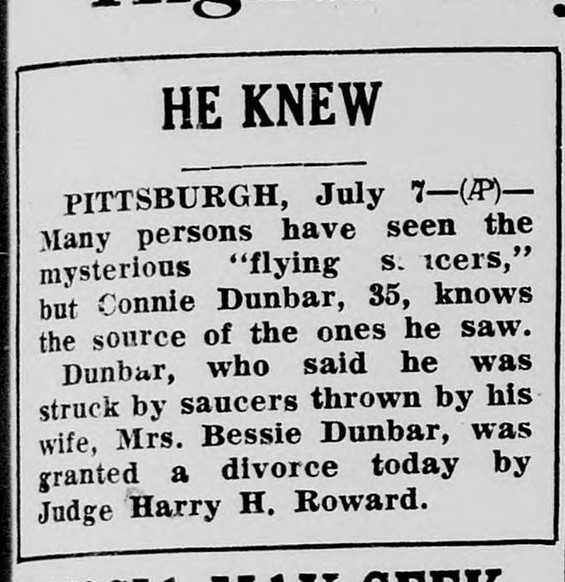
News is made up of text and context, but memory meshes them up.
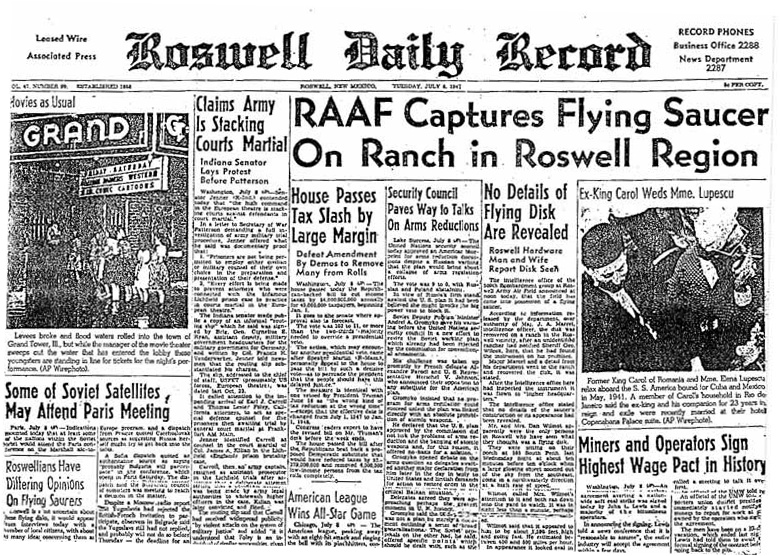
The text from 8 July 1947 is famous. Something shiny crashed in New Mexico, the Roswell Army Air Force base issued a press release about a recovered “flying disc”, the press release was retracted later the same day, and a conspiracy theory was born.
The context is compelling. In late June, there had been a widely reported sighting, and within days, the press was using “flying saucer” and “flying disk”. Many other sightings followed, and after a fortnight the story was everywhere. Take the front page of the Roswell Daily Record for the day in question. The story which has lived is on the right. But look at the smaller story on the left, “Roswellians Have Differing Opinions On Flying Saucers”:
By August, a Gallup poll found that 90% had heard about flying saucers or flying disks, and by 1950, a Gallup poll had 94% having heard the terms, well ahead of “Cold War”.
Meanwhile, there are awards for two other US newspapers for their 8 July issues.
First and gold to Washington DC’s Evening Star. On its sports page, it reported:
Names of prospective nominees for a September 19 shot at Joe Louis and his heavyweight crown were skimming around Jacobs Beach like flying saucers today – and provoking just as much bewildering comment and speculation as the dipsy-doodling discs.
And earlier, on page 2, just below a sobering “Reports From Experts Lend More Serious View to ‘Discs'”:
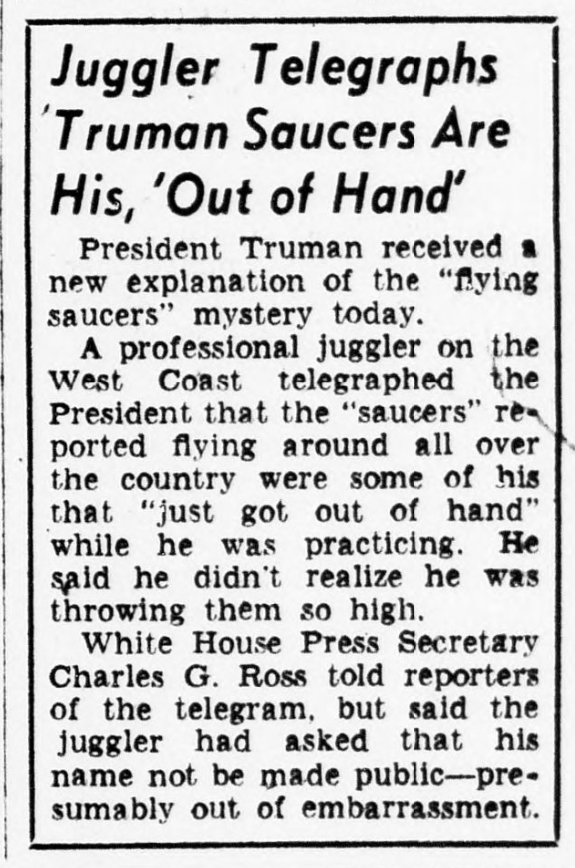
A worthy silver to North Carolina’s Wilmington Morning Star: