Forever and a day, politicians under monarchs have had to concern themselves about the issue, what happens if the monarch is not producing issue? “What do we do to ensure a smooth line of succession?” Like much of life’s mysteries, this involves sex, religion and territory.
At the beginning of the 18th century, the English government was faced with just this problem. The deposed Catholic Kind James II had provided two Anglican daughters, each of whom would become Queen, and a distinctly Catholic and Francophile son, known to history as the Old Pretender. There were some Protestant relatives in Hanover, so the Act of Settlement was passed upon a sentiment, “better a German prince than a French one”. It was quite a pruning of the family tree, with 56 Catholics having a better claim being axed. In 1714, the Hanovers arrived in the form of King George I.
At exactly the same time, the Hapsburgs were having their own dynastic issues. The elder brother would take over the Austrian Empire, the other would take over the Spanish Empire, and if neither had a son, the elder brother’s daughters would succeed to both. This, in 1703, was the Mutual Pact of Succession.
A decade later, the elder brother was dead and the younger brother demutualised the arrangement with the Pragmatic Sanction. Soon after, in 1717, his daughter Maria Theresa was born.
In 1740, the younger brother died. What followed was a complex series of events known as the Austrian War of Succession, the battle for whether Maria Theresa could become Empress of the Holy Roman Empire. It was a world war, with offspring in India and North America and subsuming an ongoing spat in the Caribbean known as the War of Jenkins’ Ear.
Alignments chopped and changed. Oddly to the modern eye but understandably at the time, the French and the Prussians were against Maria Theresa, while the so-called Pragmatic Army included with the Austrians, the British and the Hanovers.
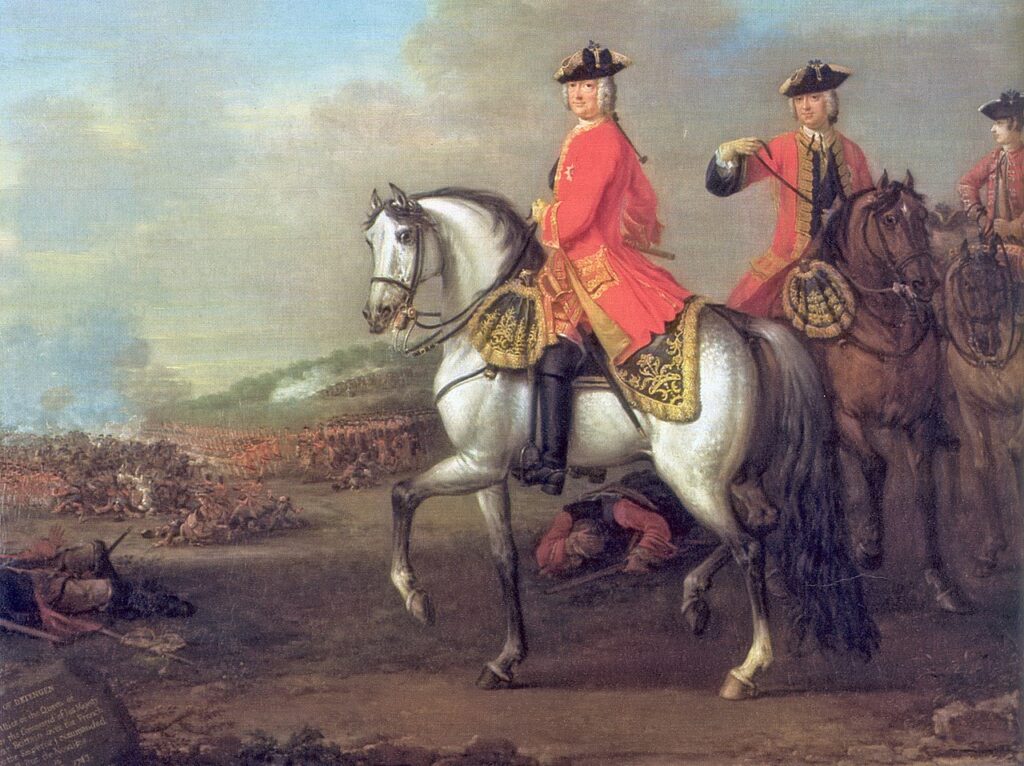
On 27 June 1743, the Pragmatic Army met French forces in the Battle of Dettingen and the Army was successful. Present was George, son of King George I of Great Britain and now King George II. Although, and as can be forgotten, he was also there as the reigning Duke of Hanover and, by virtue of this, one of the prince-electors, the members of the electoral college that elected the Holy Roman Emperor, albeit for some time a rubber stamp for the Hapsburgs.
And so, 27 June marks the most recent time that a reigning British monarch to lead troops into battle.