At the beginning of the 21st century China became a member of the World Trade Organisation. Whatever the politics of that process, there is the curious reality that prior to the event, there was something called the “World Trade Organisation” which was a trade organisation omitting the then most populous country in the world. A curious reality with a history all its own.
Well over a century ago on 2 January 1900 US Secretary John Milton Hay informed President McKinley’s cabinet that the Great Powers had agreed to a US proposal that China’s commercial doors be kept open on equal terms. The New York Tribune of the following day reported it in these terms:
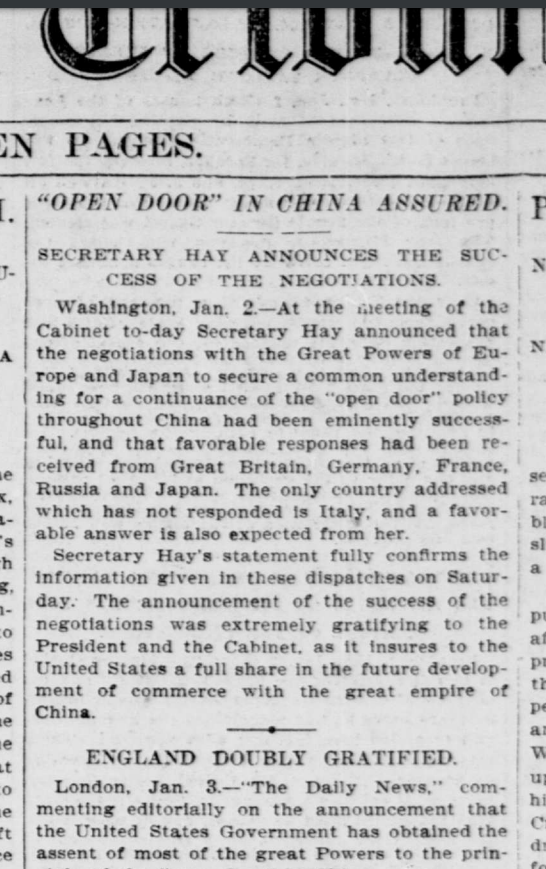
A year later, the US was a signatory to the Boxer Protocol by which the Great Powers imposed their indemnity on the aforesaid great empire of China for the Boxer Rebellion.
A huge debate about whether China should be permitted to pay in silver or in gold soon erupted. By January 1903, the same newspaper was putting the issue in terms familiar to us, wrapping up national self-interest, global concerns and morality:
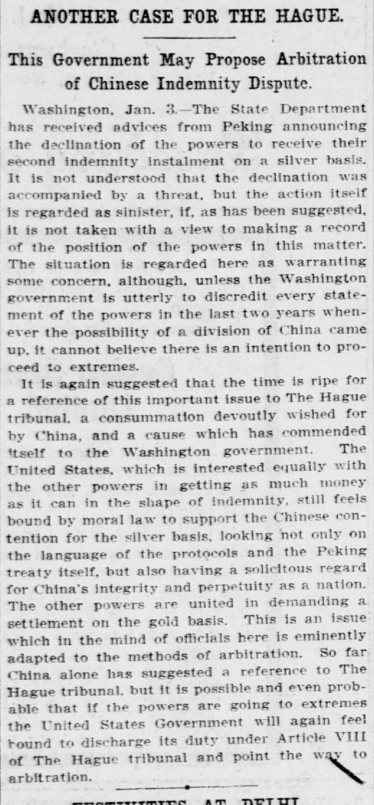
It’s number two day in the year, so two observations will do.
First and whatever westerners think of China’s domestic practices, it behoves us to remember that China’s suspicions when it comes to bargaining tables with westerners have some justification in history. It is no irony that Deng Xiaoping’s policy which laid the foundation of China today was launched in 1978 as an Open Door Policy.
Secondly, these episodes are excellent examples of the peril of mixing morality and national self-interest. President Wilson’s post-Great War travails with a League of Nations and an indemnity-ridden Germany are another example; for some of us, the War on Terror was another. Whether the peril is a risk always to be taken is a matter for each of us. I merely record the words of Lord Salisbury, Britain’s Prime Minister during the episodes. Forty years earlier he had written:
No one dreams of conducting national affairs with the principles which are prescribed to individuals. The meek and poor-spirited among nations are not to be blessed, and the common sense of Christendom has always prescribed for national policy principles diametrically opposed to those that are laid down in the Sermon on the Mount.
Leaders of Christian countries have ease in telling their peoples to render unto Caesar. The problem in a global world is working out when to tell them to render unto a Suleiman, an Alaric or an Attila as well.