In the women’s movement, as in others, distinctions and tensions between suffrage, liberation and equality can be hidden by time.
The women’s movement in the US, or at least its most public manifestation, ran alongside abolition. Early leaders and their husbands were often well-to-do Quakers who had the means to be deeply involved with abolition at a national and international level.
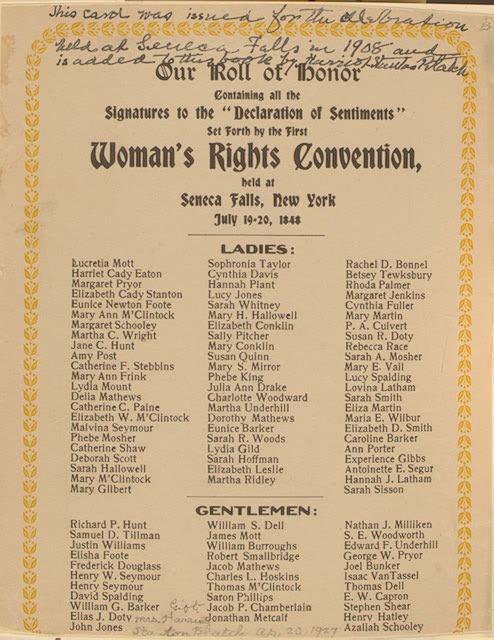
19 July 1848 was the first of a two-day meeting at Seneca Falls organised by such leaders and the first women’s movement convention in the US.
The meeting resulted in many delegates signing a Declaration of Sentiments, modelled on the Declaration of Independence. Compare
We hold these truths to be self-evident, that all men are created equal…
with
We hold these truths to be self-evident: that all men and women are created equal…
Surprising for the modern age is the fact that suffrage was only adopted as a women’s right after vigorous opposition. One of the vocal supporters of a woman’s vote was Frederick Douglass, the only black male. He signed, and his name is recorded on, the Declaration, pictured below.
Suffrage continued to mean different things to different women. After the Civil War, some saw sense in siding with the southern white opposition to a black male franchise. And later, some working-class women, who saw little advancement for their husbands in any extensions of the male franchise, continued to regard the suffrage issue as an irrelevant distraction.