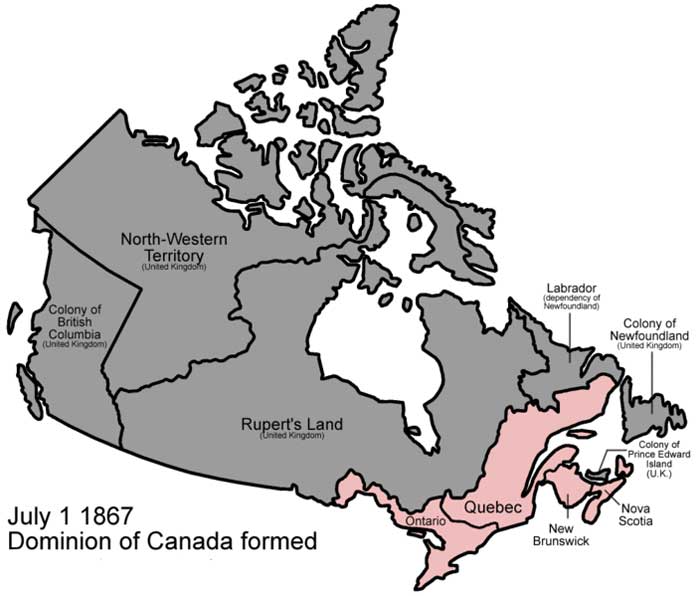
On 1 July 1867, the UK’s British North America Act came into effect. It is rich fodder for semanticists.
The preamble to the Act opens with the words:
Whereas the provinces of Canada, Nova Scotia, and New Brunswick have expressed their Desire to be federally united into One Dominion under the Crown of the United Kingdom of Great Britain and Ireland, with a Constitution similar in Principles to that of the United Kingdom…
After the Great War, the 1926 Imperial Conference and the 1931 Statute of Westminster, the word “dominion” developed a particular meaning within the UK aegis. For Canada, Australia, New Zealand and a couple of other countries, it meant, more or less, dominion over domestic matters and a continuing but lessening dominion by the UK over international questions. Its appearance in the 1867 Act was prototypical.
By the bye, the UK’s constitution is notoriously unwritten, and the nature and extent of the written words “a Constitution similar in Principles to that of the United Kingdom” has kept many a Canadian jurist up late over the years.
The preamble continues:
And whereas such a Union would conduce to the Welfare of the Provinces and promote the Interests of the British Empire…
A decade later, Disraeli would push through an act which resulted in Queen Victoria having the title “Empress of India”. But no monarch has ever been known as the Emperor / Empress of the British Empire. I think I am correct in saying “British Empire” appears in only two UK Acts, this and the 1931 China Indemnity (Application) Act, which dealt with the winding down of the indemnity imposed by western nations on China after the Boxer Rebellion.
As for the word “Canada”, it means settlement. The Act resettled it. The province of Canada, as we have seen, is in the preamble. By section 4, it becomes one of the three provinces of the “One Dominion under the Name of Canada”. By section 5, Canada is said to comprise four provinces, Ontario, Quebec, Nova Scotia and New Brunswick. And by section 6, all is explained. That bit of the Province of Canada which had formerly been “Upper Canada” was the “Ontario” and that bit which had formerly been “Lower Canada” was the “Quebec”.
Finally, section 10 discusses the role of the Governor General. The section includes, for the first time in a UK Act, the now ubiquitous “Chief Executive Officer”.