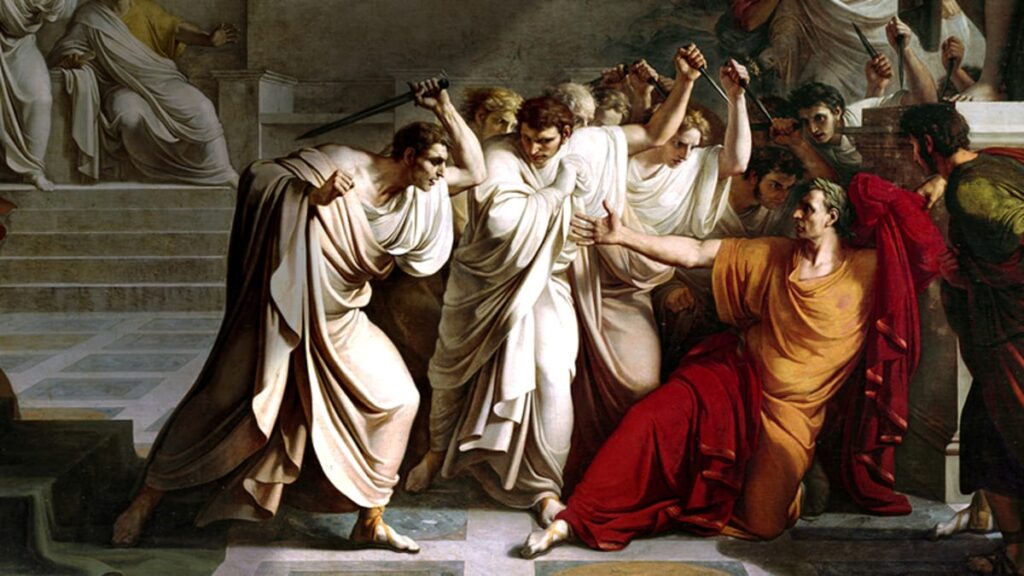
Gaius Julius Caesar was born on 12 (or 13) July in what we now call 100 (or 102) BC. It is enough for great people to have fame; the peculiar feature of Caesar is how he got the name and how others have since used it.
Romans had three names, the personal first, the family second, and the third, the cognomen, which by the time of Caesar’s birth meant a branch on the family tree: “I am Gaius, a Caesar in the Julian line.”
The debate of the origin of the cognomen is summarised in the Historia Augusta. The Caesar referred to is possibly Numerius Julius Caesar, born about 200 years before the more famous Julian:
Now whereas I must needs tell something of the name of the Caesars, particularly in a life of the man who received this name alone of the imperial titles, men of the greatest learning and scholarship aver that he who first received the name of Caesar was called by this name, either because he slew in battle an elephant,which in the Moorish tongue is called caesai, or because he was brought into the world after his mother’s death and by an incision in her abdomen, or because he had a thick head of hair when he came forth from his mother’s womb, or, finally, because he had bright grey eyes and was vigorous beyond the wont of human beings. At any rate, whatever be the truth, it was a happy fate which ordained the growth of a name so illustrious, destined to last as long as the universe endures.
When Gaius Julius, as a prelude to his dictatorship, illegally issued his own coinage, he chose the elephant. The symbol of the might of his legions has been suggested, but I suspect that the symbol of stability was an important element of the usurpation.
As to the other end of things, “Caesar” developed over about a century from “I use Caesar in my name to indicate my descent from Julius Caesar” to “I use Caesar because I rule you”. Both “kaiser” and “tsar” are direct descendants of the latter use. A cheeky use was adopted by rulers of the Ottoman Empire from the conquest of the remnant of the Eastern Roman Empire in 1453 until just after the Great War; Kayser-i Rûm, the Rûm being the second Rome, Constantinople.
When the English ruled one quarter of the globe, there was a marked ambivalence about going beyond the good old English “king”. Although the “British Empire” was already a well-known trope, no monarch had ever been called “Emperor of the British Empire”. Victoria was keen on “Empress of Great Britain, Ireland, and India” but Disraeli managed to tone her down to Empress of the last.
However, there was a difficulty. For various reasons, “emperor/empress” was a no-go with the locals, and there were religious and other difficulties with “padishah” and like terms. Scholar GW Leitner came up with the neologism Kaisar-i-Hind , and so from 1876, Victoria was Kaisarin-i-Hind.
When we recall the origins of the Great War, we often recall the family relationships of the rulers of the combatants. Another way to think of it, or at least of the participants Germany, Austria-Hungary, Bulgaria, the Ottoman Empire, Great Britain and Russia, is to imagine six four kaisers and two tsars.
As for the US, there is the well-known biography of General Macarthur, American Caesar. He was relieved of command in 1951. In an unrelated move, New Yorkers began and Canadians have since developed, the Bloody Caesar, a Bloody Mary with clam juice.